
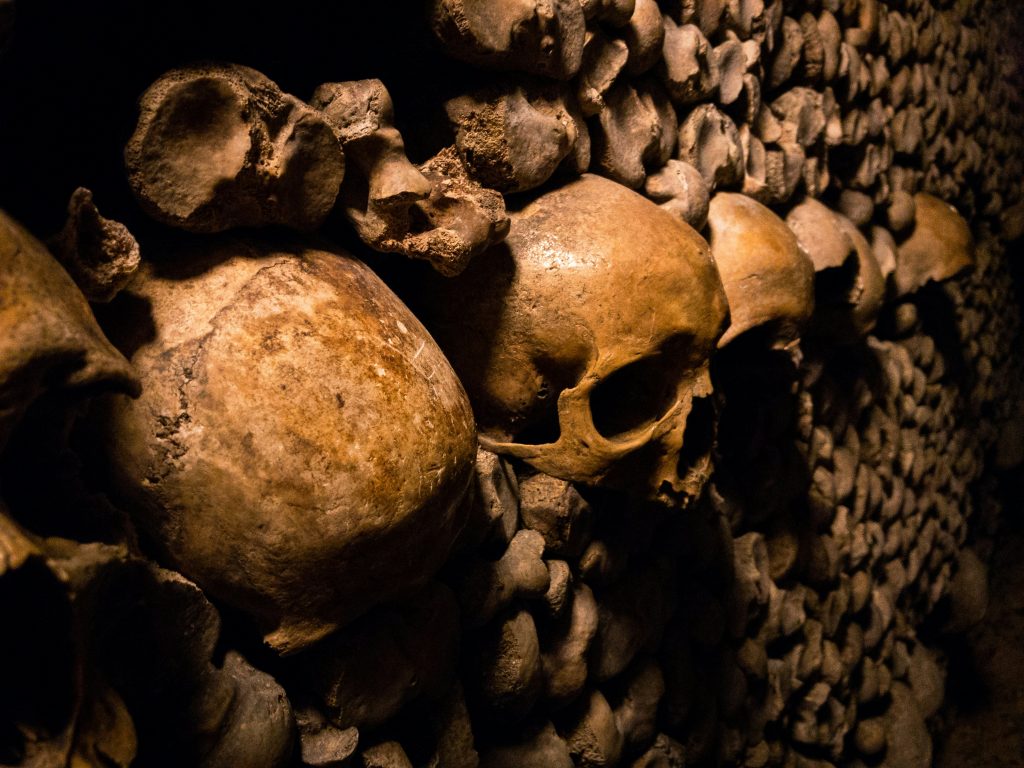
What is the history of the Catacombs in Paris? It begins in the late eighteenth century, when overcrowded cemeteries created severe public health risks inside the city. Faced with collapsing burial grounds and growing sanitation concerns, Paris authorities made a decisive choice: they transferred millions of skeletal remains into abandoned limestone quarries beneath the Left Bank. Over the following decades, workers reorganized those tunnels into a formal municipal ossuary, which later opened to visitors. The purpose of the Paris Catacombs was practical from the start – protect the living by relocating the dead – before the site evolved into a historical landmark.
If you are planning a trip, download our Free Ultimate Paris Travel Guide for deeper cultural context before you visit.
Why Paris Needed the Catacombs

To get to grips with what the history of the Catacombs in Paris actually is, and why they were built, we first need to look at Paris in the 1700s.
At that time, most cemeteries stood inside the city walls. As the population grew, neighborhoods expanded around burial grounds that had once stood outside the urban core. The Cemetery of the Innocents, in particular, had served the city for nearly a thousand years.
Gradually, graves were reopened to make space for new burials. Workers stacked bones in charnel houses, and layers of remains rose above street level. As conditions worsened, odors spread and structural risks increased.
Then, in 1780, a basement wall near the Cemetery of the Innocents collapsed under the pressure of accumulated remains. Bones spilled into an adjacent property. This incident forced officials to act.
The purpose of the Paris Catacombs was clear. Authorities needed a safer solution that addressed both sanitation concerns and unstable ground. Undoubtedly, this became a turning point in what is the history of the Catacombs in Paris.
From Quarries to Ossuary – The 18th-Century Transformation
While cemeteries created problems above ground, abandoned quarries created dangers below. For centuries, builders had extracted limestone from the Left Bank. Once depleted, many tunnels remained unsupported, and collapses became frequent, shaping the origins of the history of the Catacombs in Paris.
In response, King Louis XVI established the General Quarry Inspection in 1777. Engineers mapped and reinforced vulnerable sections of the underground network. As a result, the strengthened tunnels offered a practical destination for relocated remains.
Beginning in 1785, workers transferred bones from the Cemetery of the Innocents to the former Tombe-Issoire quarries. Night after night, processions crossed the city. Over the next decades, remains from additional cemeteries followed. In 1786, officials formally consecrated the underground site as the Paris Municipal Ossuary.
At first, quarry workers simply deposited the bones in large piles. Still, this phase marked a turning point in the Paris Catacombs’ transformation—one can ask, what is the History of the Catacombs in Paris during this era?
How the Catacombs Became a Monument
In the early nineteenth century, the ossuary took on a new character. Under the direction of Louis-Étienne Héricart de Thury, workers reorganized the galleries. They arranged femurs into structural facades and placed skulls at the surface in careful geometric patterns. This period is also a major chapter in the history of the Paris Catacombs.
In addition, stone plaques and inscriptions lined the route. These design choices encouraged reflection rather than shock. Soon after, authorities opened the site to visitors by appointment, and interest grew steadily.
Through these changes, the Catacombs shifted from emergency storage to structured memorial space. Notably, this transition forever altered what is the history of the Catacombs in Paris.
The Catacombs of Paris Today
Today, the Paris Catacombs contain the remains of more than six million people. Only a small section of the original quarry network is open to the public, following a defined path beneath the streets near Denfert-Rochereau. The current public fascination with the Catacombs continues as people ask what is the history of the Catacombs in Paris and how it reflects the city’s past.
Although the Catacombs began as a response to crisis, they now stand as a preserved historical site. Their history reveals how Paris addressed overcrowding, stabilized its underground, and reshaped part of the city beneath its streets.
If you would like to explore the Catacombs with expert guidance and place their history within the broader story of Paris, our team at My Private Paris can design a tailored visit that fits naturally into your itinerary. You can also book a complimentary call with one of our travel designers to begin planning your stay.